Table of Content
In modern high-tech industries, material selection is no longer solely based on price; it must also consider strength, temperature resistance, thermal conductivity, and processability. Especially in extreme conditions such as semiconductor manufacturing, vacuum furnaces, aerospace engines, and heat exchangers, molybdenum—a metal that is often overlooked but extremely important—is a trump card in the hands of engineers.
Basic properties of molybdenum: excellent in both melting point and thermal conductivity.
Molybdenum is element number 42 in the periodic table, a transition metal, and possesses the following amazing physical properties:
| Material | Melting point (°C) | Thermal conductivity (W/m·K) | Coefficient of linear expansion (μm/m·K) | Density (g/cm³) | Difficult to process |
|---|---|---|---|---|---|
| 鉬 | 2623 | 138 | 4.8 | 10.28 | ★★★★☆ |
| 鎢 | 3422 | 173 | 4.5 | 19.25 | ★★★★★ |
| 鋁 | 660 | 235 | 23.1 | 2.70 | ★☆☆☆☆ |
| 銅 | 1085 | 401 | 16.5 | 8.96 | ★☆☆☆☆ |
| graphite | 3550 | ~110–120 | negative value | 2.25 | ★★☆☆☆ |
Molybdenum's high melting point and high thermal conductivity make it the preferred material for applications requiring both high temperature resistance and thermal conductivity. Compared to tungsten, which is expensive and extremely difficult to process, molybdenum has become a cost-effective and efficient alternative for many industrial applications.
Semiconductor Industry: Essential Metals for Ion Implantation Machines and Etching Chambers
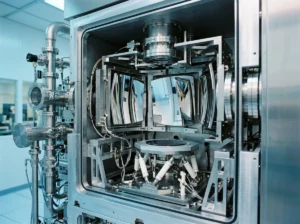
In semiconductor manufacturing processes, several key components face extremely high heat loads and severe plasma corrosion, including:
- Absorption plate of ion implantation machine
- Shielding plate or structural support of plasma etching cavity
- Reflective elements or heat sinks in high-power laser equipment
The common requirement for these components is:High thermal conductivity, resistance to thermal deformation, and excellent corrosion resistanceTraditional methods of using aluminum can lead to melting, and stainless steel can cause deformation. This is where molybdenum comes in. Some high-end etching equipment manufacturers even choose molybdenum alloys (such as titanium-zirconium-molybdenum alloy TZM) to further improve mechanical properties and lifespan.
Vacuum and aerospace applications: withstanding extreme pressure and heat
Molybdenum exhibits excellent stability in a vacuum environment, is not easily vaporized, and does not release gas, therefore it is widely used in:
- Heating elements and supports in a vacuum furnace
- High-temperature ceramic sintering support tray
- Thermal protection structure inside aerospace thrusters
In the aerospace field, molybdenum is also commonly used in thermal protection systems (TPS) or heat transfer layers in high heat flux areas, such as heat exchange components in the tail section of rockets. Compared to tungsten, molybdenum offers lighter weight and better processability, making it a good material for aerospace designers to weigh their options.
Processability and cost assessment: Acceptable technical threshold
Molybdenum is not as easy to machine as aluminum, but it also doesn't have the infamous reputation of being a "tool killer" like tungsten. Common machining methods for molybdenum parts include:
- Machining after isostatic pressing and sintering
- EDM (Electrical Discharge Machining) or Laser Cutting
- Welding and surface coating (molybdenum can be welded to stainless steel, but vacuum or inert gas protection is required).
In terms of price, molybdenum is around 60-80 USD/kg, which is much cheaper than tungsten, which often exceeds 100 USD/kg, but its performance is still superior to that of ordinary metals.
How does molybdenum emit light and heat in critical scenarios?
- Semiconductor industry experience sharing: A Taiwanese wafer equipment manufacturer changed the baffle material of the etching chamber from graphite to molybdenum, which increased the life of the components by nearly 3 times, reduced downtime, and significantly reduced maintenance costs.
- Aerospace heat exchange module: A European and American aerospace manufacturer uses a molybdenum heat sink design to recover the heat energy of rocket exhaust. The excellent thermal conductivity of molybdenum improves the overall system efficiency.
Under what conditions should molybdenum be selected?
- If your application temperature exceeds 1000°C
- It also needs to have a certain thermal conductivity (>100 W/m·K).
- Sensitive to gas release (e.g., vacuum furnaces, etching machines)
- When considering weight and cost, the limits of tungsten cannot be met.
Key materials you may have overlooked but should know
Molybdenum, unlike aluminum and copper, is not as common, but it plays an irreplaceable role in modern high-tech processes. Its applications are expanding in vacuum, plasma, high-temperature, and aerospace fields. If you are an equipment developer, thermal engineer, or a material selection decision-maker, molybdenum should be on your watchlist.